Can AI Make the Final Hiring Decision? Why It Shouldn't, Even When It's Right
No. Let AI rank and summarize, but a named person makes the final hiring decision. Why people end up signing instead of deciding, and 3 steps to fix it.
- Less legal risk
- Fairer hiring
- Better hires
Nov 2, 2026 · 3 min read
Picture a founder at 7 pm on a Thursday, with two finalists for the company's first operations hire. The hiring tool scored one at 91 and the other at 84. The founder liked the 84 more in the interview, can't say why, and is tired. Clicking the 91 feels safe.
The short answer: AI should not make the final hiring decision, and in a small company it matters even more. Let it rank, summarize and point out gaps, but the last call belongs to a named person who checks the evidence and can explain the choice. Not because the model is always wrong, but because people quietly copy its mistakes, and "the tool picked them" answers nothing when a hire goes bad.
The rubber stamp problem
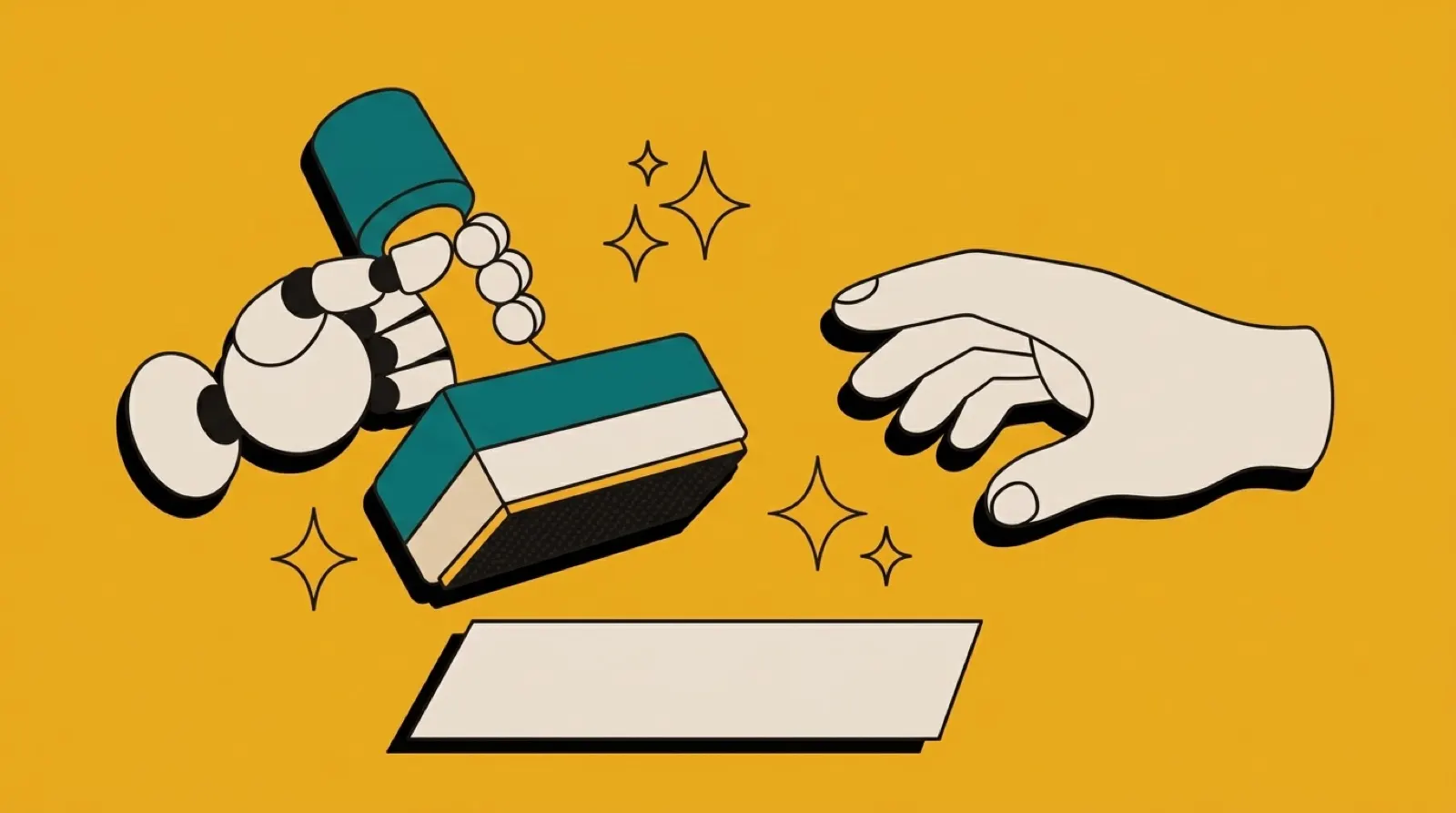
The usual safeguard is "a human reviews it". The research says that human often doesn't. In a 2025 study by Wilson, Sim, Gueorguieva and Caliskan (presented at the AAAI/ACM conference on AI, Ethics, and Society), 528 people screened candidates with help from an AI that had race-based preferences. Without AI, or with a neutral one, they picked candidates of all races at equal rates. With the biased AI, they followed its preferred group up to 90% of the time.
So the founder clicking 91 isn't deciding. They're signing.
What deciding actually looks like
A real decision has three parts, each a few minutes:
- Read the evidence, not the score. Ask the tool to quote what each finalist said or did behind its ranking. Then find each quote in your own notes or transcript. If it isn't there, it doesn't count.
- Write one sentence on why. "I chose B because she walked us through how she cut onboarding time, with numbers." If you can't write it, you haven't decided yet.
- When you go against the tool, name the evidence that outweighs the score. A feeling isn't a reason. The record shows a person was in charge.
The whole record fits in a few lines:
Role: Operations lead
Finalists and tool score: A 91, B 84
Evidence quotes checked against my notes: yes / no
My decision: B
Why, in one sentence: [the evidence, quoted from my notes]
Went against the tool? Yes. What outweighed the score: [evidence]
Who answers for it
A big company absorbs a bad hire. A 12-person company can lose a quarter to one, and you answer for it. Candidates are wary already: only 26% of job applicants trust AI to evaluate them fairly, according to a Gartner survey release from July 2025.
The law points the same way. In Europe, GDPR Article 22 gives people the right not to be subject to a decision based solely on automated processing when it significantly affects them. In the US, Mobley v. Workday, a suit claiming an AI screening tool shut out applicants over 40, is still moving forward in federal court in 2026, with no ruling yet on whether the software discriminated. For what applies where you hire, your lawyer gets the last word; this article isn't legal advice.
"But people are biased too"
They are, and this counterargument is strong. In a study of 15 firms hiring service workers, published in the Quarterly Journal of Economics in 2018, Hoffman, Kahn and Li found that managers who hired against a job test's recommendation ended up with worse hires on average.
But look at what it tested: managers overriding a structured test on gut feeling. That's why step 3 asks for evidence, not a feeling. Our founder shouldn't click the 84 on a hunch either. They should find out what the hunch is about, check the interview notes, and decide with a sentence to show.
Next step: give yourself evidence worth reading by building a structured interview with AI, and see what the rules ask of employers using AI.
This article is general information, not legal advice. Laws differ by country and change often, so consult your lawyer before you rely on it for your situation.